Authentically Human! Not Written by AI!
All Content Copyright © Michael Chesley Johnson AIS PSNM

Friday, December 15, 2006

Plein Air - Not for Everybody

I taught a lot of workshops last summer, and I ran into all kinds of students. Some had purchased their first paints -- ever -- just for my workshop. They didn't even know what colors to buy, and they were glad to have me help choose. Others, Sunday painters who find time to paint only when the family is out shopping, came to me so they could get better, fast. Others had been painting professionally for years and wanted a break from what they usually do and stretch their horizons.

Among all these groups were many who knew little or nothing about painting outdoors, but who wanted to learn.

What possesses a person to fancy himself an outdoor painter? I always thought of myself as a camper, but after a few years of flooded-out tents, mosquitoes trapped in my sleeping bag and camp stoves that failed me a hundred miles away from the nearest restaurant, I learned something about myself. I'm not a camper. (I don't care much for hotels, either, but that's another story.)

In a similar way, some artists aren't outdoor painters. It's not just the paint that gets smeared on the driver's seat of the car, or the mosquitoes and the blackflies, or the wind and intermittent drizzle. Sure, these things contribute, but I've always found that once I'm "in the zone," as we painters like to say, they are inconsequential. More important is your approach to painting.

It all has to do with time and focus. An experienced outdoor painter learns quickly to eliminate the 359 degrees of the panoramic landscape and focus on the 1 degree in front of him. He learns to establish color and value quickly. If he's no good at judging color accurately, then he makes a choice about what colors to use and sticks with it, no matter what.

I like to think of my painting as a "performance piece." I do my best to exercise my skill, but like a concert pianist, I have no opportunity for revision. Time, and the accompanying shifting of light and shadow, of weather and tide, does not permit it.

Some artists aren't performers. Making judgments rapidly and sticking by them makes them uncomfortable to the point of frustration. On the other hand, there's nothing more pleasurable to them than the more contemplative practice of laying down a stroke, considering it, and if it doesn't fit, wiping it out. They are more like the studio musician who enjoys the freedom to try different chords, different tempos, to see what's best before recording.

There's nothing wrong at all with one temperament or the other.

I encourage my students who discover that they don't have the temperament for painting outdoors to consider the week with me all part of Continuing Education. I want them to go back to their studios, enriched from the experience but also satisfied in the knowledge that how they do things is just another way of making perfectly good art.

Monday, December 11, 2006

First Snow

Our first real snow came to the Canadian Maritimes a few days ago. It wasn't much, but still, it was a couple of inches. I've been waiting for just such a snow to paint in. The snow brings out the deep reds in the brush and the greens in the bark of the maple trees. So today, I bundled up and trudged out with the easel. Here is "The Flagg House in Winter," 9x12, oil/panel:

The temperature today was 37 degrees. I wore all the winter clothes I had, including my big Sorel snowboots. Although most of me stayed quite warm, my feet became uncomfortably chilled by the end of the session. I attribute this to the cold ground and the fact that I was wearing cotton socks, which are notorious for holding moisture. Tomorrow, I'm buying a set of those insulated overalls you see construction workers wearing in the winter as well as some wool socks. I'm also buying a bunch of those little heat packets I can drop in my boots. (These are the chemical packets that generate heat when exposed to air.) I've used these when cross-country skiing, and they're a life-saver!

Thursday, November 30, 2006

Barn & Springhouse

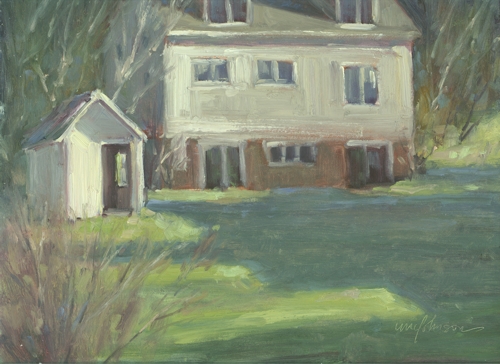
"Barn & Springhouse," 9x12, oil/panel, en plein air.
The leaves between our house and the in-laws' have all fallen, and from almost anywhere on our properties, you get interesting views of this large complex of old buildings. Barns, springhouses, expanded Capes -- you name it. These buildings are sided in the traditional narrow clapboard and painted white. (And, to be honest, many of these buildings are in sore need of scraping and painting! Winter ocean storms do a number on them.)

When it's overcast, the yellowed and greyed buildings provide a soft backdrop for the deep maroons, russets and tawny bushes. However, when the evening sun breaks out upon these white buildings, the light is dramatic, and the white glows incandescently. And, if you look at the detail, you'll see that white isn't necessarily white! There's very little pure white in this painting.

You can see details on my website in the Maritimes section.

Friday, November 24, 2006

In the Shadow of the Big House

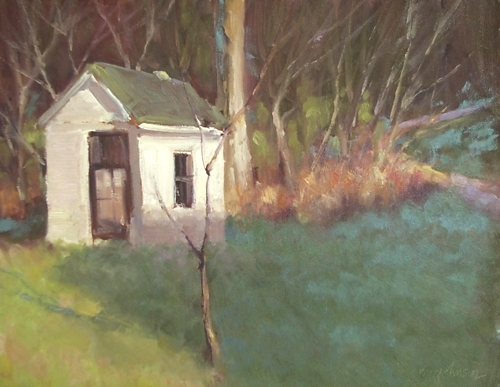
My in-laws recently bought the old 1860's Cape next to us here on the island. One of its interesting points is this little structure.

Campobello Island had some grand hotels on it at the start of the last century, but they didn't last long, and when they were torn down, bits and pieces of them were distributed across the island and incorporated into many of the homes. Some of the houses here have doors -- still with the room number on them -- from the hotel.

Anyway, one of the hotels had a pair of these little structures. Our house has one, and it has fallen into ruin and is covered with lichen and moss. My in-laws' house, however, has this beautiful one. It's still in good shape probably because it, unlike ours, which is deep in the firs and brush, sits in the open.

I love the evening light as it plays across this scene. "In the Shadow of the Big House," 8x10, oil, en plein air.

Wednesday, November 8, 2006

Sedona - Final Thoughts

After the Sedona event, I drove over to New Mexico to see my mentor, Ann Templeton (www.anntempleton.com) to visit and show her a few of the paintings. Ann was weary from two back-to-back trips -- a trip to California, and then to North Carolina, where she taught a workshop. Despite her weariness, Ann looked over my work and gave them largely unqualified praise. It feels great to get that kind of praise from a mentor.

(Above is a photo of me at the Quick Draw event, courtesy of Stephen Sanfilippo at www.stephensanfilippo.com.)

Now that Sedona is over, what would I do differently?

First, I would have done even MORE paintings that very first day. Even though I did three on the second day, I just did one on the first. At least two on the first day really would have gotten the motor started. (Not that 11 "done" paintings is a paltry number, by any means!)

Second, I would have done a few larger paintings. Although ultimately it would have meant perhaps FEWER paintings, a couple of larger ones would have allowed me to capture more of the panorama that is unique to Sedona. It also would have given my work more visual impact on the day of the final show.

Third, rather than run helter-skelter to almost a dozen different locations within a 20-mile radius of Sedona, I would have settled on simply a couple of places. For example, Red Rock State Park had a wealth of painting spots, but I spent just a day there. The pace would have been a tad more relaxed.

Other than these differences, I wouldn't have changed anything else. And I certainly wouldn't have changed much about the event itself -- it was very well-organized with a great support staff and wonderful sponsors! Would I do it again next year? You bet!