Authentically Human! Not Written by AI!
All Content Copyright © Michael Chesley Johnson AIS PSNM
Showing posts with label Encounters. Show all posts

Wednesday, June 25, 2025

Sunday, April 21, 2024

Master Artist Flashback: Interview with Stephen Quiller

View in browser

**Authentically Human! Not Written by AI**


A couple of years ago, after finishing my book, Beautiful Landscape Painting Outdoors: Mastering Plein Air, I decided to interview the artists who participated. Here’s my interview with master artist Stephen Quiller, the man who re-introduced gouache and casein to the world.  See it on my Substack! Https://mchesleyjohnson.substack.com

Sunday, May 7, 2023

Encounter: Don Weller

View in browser

**Authentically Human! Not Written by a Bot**


I have to admit, as an artist living in the West, I don't particularly care for Western Art.  Painting such subject matter today—cowboys, horses, the American Indian—seems like a holdover from the days of Frederic Remington in a desperate attempt to sell paintings to a nostalgic modern public.  (The same might be said about landscape painting, a holdover from the days of Thomas Moran, but I digress.)  Some Santa Fe galleries are full of cowboy paintings, and I pass them by.  It's rare when a piece of Western art catches my fancy.

Recently, I was approached by my editor to interview Utah artist Don Weller, who paints cowboys and horses.  I wasn't too excited about the project initially, but when I started to view his work—it was all new to me—I was hooked.  His work is filled with sparkling color, brilliant brush work and figures of horses and men that possess a quality so dynamic they seem to jump off the page.  To help with research for the article, Don sent me a copy of his book, Don Weller Tracks: A Visual Memoir, which is a hearty "rancher's breakfast" of images with just a peppering of words.  The paintings reproduced therein confirmed my opinion that Here is Western Art I Can Love.

But what makes Don different from the run-of-the-mill painter of Western Art?  He's lived the life, and I can sense this in his paintings.  His work is honest, genuine, made from a lifetime of careful observation and love.

When growing up in eastern Washington State, Don convinced his parents, who knew nothing about horses, to get him one.  He started riding, roping calves and participating in local rodeos.  A fascination with cowboys and horses permeated his childhood.  After graduating from college with a degree in Fine Art—he'd drawn his favorite subjects throughout his early years—and not quite sure what to do, he joined the Air Force for a stint and then moved to Los Angeles for work.  Thus began a decades-long career in graphic design and illustration, with some of his clients being Time Magazine, the Hollywood Bowl, the National Football League, the 1984 Olympics and the US Postal Service, for which he designed five stamps.

Then, tired of the big city, he and his wife (Chikako "Cha Cha" Matsubayashi, also his work partner) moved to a rural part of Utah.  "The rural West with mountains, sagebrush and cowboys—it was still there, just as I left it so long ago."   Not only did he return to riding horses, he also returned to depicting his beloved subject matter in watercolor and oil. Today, Don continues to paint the kind of Western Art I like.

I've included a few images from his website here.  My interview with Don will be in the Fall 2023 issue of Watercolor Artist.  It was a real pleasure to come to know him.  You can see more of his work at www.donweller.com.

Eyes on the Horns
watercolor 17x26.5

In the Corner, Ennis
watercolor, 9x7

Pasture Trio in Autumn
oil, 10x14

Scratching Out a Ride
oil, 18x24

Tanner
watercolor, 13.5x11.5

The Rockies
oil, 30x42


Thursday, February 23, 2023

Encounter: At Bluebird Studios with Albert Handell, Roberta Remy and Michael Chesley Johnson UPDATED

View in browser

Click this to view

(This is an updated version of the video I posted a few days ago.  I have added a ton of "visuals" to alleviate the somewhat-overwhelming "talking head" effect.  If you watched the old version, watch this new one--I think you'll like it!)

To help promote Bluebird Studios and our workshops in Santa Fe, Roberta Remy and I recently chatted with Elizabeth Cooper, owner of the studio, and Albert Handell.  Elizabeth opened her workshop center last year, and in the video, she talks about what makes hers unique.  She also invited Albert, Roberta and me to comment on why students would find an "in-person" workshop more beneficial than one given online; on what students can expect in taking one of our workshops; and, on a personal note, what drew us to Santa Fe and New Mexico.  I think you'll find this 24-minute discussion enlightening, and you can view it here, below.  (Can't see the image? Here's a link.)


(click to play)

Although Albert isn't teaching a workshop at Bluebird Studios, we each have had a long friendship with him.  To help us out, he has graciously offered to open his studio to our students for a visit.  (Thank you, Albert, for your generosity!)  I've visited Albert many times—I even helped him with a workshop there—and it is fascinating to be in the midst of all that mastery and genius.

My plein air painting workshop runs May 6-9, 2023, and until the end of February, you can get $40 off with discount code MCJ40.  Go here to for more details or to sign up.  Roberta's portrait painting workshop runs May 17-20, 2023.  For details or to sign up, go here.

By the way, I discovered something during the interview—Albert and Roberta have known each other for many, many years.  They were students together at the Art Students League of New York.  "We were both under 20," Albert said.  In talking with Albert and Roberta in a different conversation, I learned about their  long history together.  I suggested that it would be fun to interview the two of them together as they reminisce...so, stay tuned!

Sunday, April 24, 2022

Encounter: Interview with Lorenzo Chavez

View in browser

View the Interview Here


For the last of my interviews of artists participating in my new book, I interviewed master artist Lorenzo Chavez.  

A native of New Mexico, Lorenzo was first inspired by the New Mexican landscape and the long succession of other artists who have found inspiration in the area.  Although he now makes his home near Denver, he continues to travel and to paint the American Southwest and the West.

Lorenzo graduated with honors from the Colorado Institute of Art in 1983 and continued his art education at the Arts Students League of Denver, starting in 1987.  He's painted professionally for over 35 years, working in both oil and pastel.  His work has won many major awards and is in many major collections, both here and abroad. A much-sought-after workshop instructor, he continues to teach throughout the US.

I'm very pleased that Lorenzo was able to contribute to my book, and it was a delight to interview him.  You can watch the interview below.  (Can't see the video?  You can see it at this link.)


You can watch all the interviews on this playlist here. This concludes my series of the artists who wished to be interviewed.

In case you haven't heard about my book, Beautiful Landscape Painting Outdoors: Mastering Plein Air, features 15 master artists who share their tips and techniques for plein air painting.  This 160-page book is packed with demonstrations, illustrations and, of course, beautiful paintings.  The book is available from both Amazon and Barnes & Noble.  You can get details at the following links:

Sunday, February 13, 2022

Encounter: Interview with Sandra Nunes

View in browser


In my ongoing series of interviews with artists who participated in my new book, I recently interviewed master Brazilian artist and pastel painter Sandra Nunes, who lives in her native city of Rio de Janeiro, which has inspired much of her work.  Sandra received her Bachelor in Letters and Arts at Rio de Janeiro Federal University and has traveled abroad extensively where she studied paintings by all the great masters including her favorite painter, Joaquin Sorolla.  Her paintings, which have won awards in many painting competitions, can be found in both private and public collections, including the Brazilian Navy, the Rio Zoo Foundation and Rio de Janeiro Federal University.  Sandra, as you'll learn, enjoys not only painting the outdoors but also painting portraits and from the figure, as well.

Sandra and I are both charter member artists of a group called Landscape Artists International.  About ten years ago, the charter member artists had a traveling exhibit of paintings that we called Far and Near: The World Tour of Contemporary Landscape Artists.  Sandra and I were both in the show, and we've stayed in touch ever since.  Some day, I will visit Brazil and paint with her.  (Can't see the video below? Go to this link.)


In case you haven't heard about my book, Beautiful Landscape Painting Outdoors: Mastering Plein Air, features 15 master artists who share their tips and techniques for plein air painting.  This 160-page book is packed with demonstrations, illustrations and, of course, beautiful paintings.  The book, which will come out March 2022, is available for pre-order from both Amazon and Barnes & Noble.  You can get details at the following links:

Sunday, February 6, 2022

Encounter: Interview with Kim Lordier

View in browser

Watch the interview here


As part of my ongoing series of interviews with artists who participated in my new book,  I recently interviewed California artist and pastel painter Kim Lordier.  Kim holds top designations in several organizations, including Signature Memberships in the California Art Club, the Laguna Plein Air Painters Association and the Pastel Society of America, as well as Distinguished Pastelist in the Pastel Society of the West Coast.  Her award-winning paintings have been shown  in many major exhibitions such as the Coors Western Art Show, and they have been published in magazines and books.  Kim also teaches workshops across the US.  (Visit www.KimFancherLordier.com for more.)

I first met Kim years ago at my first IAPS (International Association of Pastel Societies) convention in Santa Fe.  I hope to see her again in person this May, again in Santa Fe, at the Plein Air Convention and Expo.  We are both on the faculty. I'm very pleased that Kim agreed to be in my book and to sitting for the interview.  Thank you, Kim!


You can watch all the interviews on this playlist

In case you haven't heard about my book, it features 15 master artists who share their tips and techniques for plein air painting.  This 160-page book is packed with demonstrations, illustrations and, of course, beautiful paintings.  The book, which will come out March 2022, is available for pre-order from both Amazon and Barnes & Noble.  You can get details at the following links:


Sunday, January 23, 2022

Encounter: Interview with Lyn Asselta

View in browser

Watch it Here


I spoke recently with Maine artist Lyn Asselta as part of my ongoing interviews of artists from my new book, Beautiful Landscape Painting Outdoors: Mastering Plein Air.  Lyn holds top designations in several organizations, including Master Pastelist with the Pastel Society of America and Eminent Pastelist with the International Association of Pastel Societies.  Her award-winning paintings have been exhibited in shows throughout the US as well as in France and China, and she's also a much-sought-after teacher for both studio and plein air pastel workshops. (Website:  www.LynAsselta.com

I've known Lyn for many years, and it was a pleasure working with her on the book and interviewing her for this video.  You can watch the video below or at this link: https://youtu.be/hm1Tctsyxz4


In case you haven't heard about my book, it features 15 master artists who share their tips and techniques for plein air painting.  This 160-page book is packed with demonstrations, illustrations and, of course, beautiful paintings.  The book, which will come out March 2022, is available for pre-order from both Amazon and Barnes & Noble.  You can get details at the following links:


Sunday, January 9, 2022

Encounter: Interview with Nathan Fowkes

View in browser
Watch it Here


I spoke recently with California artist Nathan Fowkes as part of my ongoing interviews of artists from my new book, Beautiful Landscape Painting Outdoors: Mastering Plein Air.  Nathan is a concept artist for animation and entertainment projects with clients such as DreamWorks, Blue Sky and Disney, and he has screen credits for 12 feature films.  But he's not just a studio artist.  As you'll learn in our interview, much of his concept art is inspired by his adventures in plein air painting.  (Visit www.NathanFowkesFineArt.com.)

I hadn't met Nathan before our interview, but when I was looking for artists to include, I was so taken by his landscape work and his expertise as a teacher that I knew right away he would add an important dimension to my book. It was a pleasure to work with him and a real delight to meet him via Zoom.  You can either watch the recording here or through this link:  https://youtu.be/jZ8iNn7zFtA


In case you haven't heard about my book, it features 15 master artists who share their tips and techniques for plein air painting.  This 160-page book is packed with demonstrations, illustrations and, of course, beautiful paintings.  The book, which will come out March 2022, is available for pre-order from both Amazon and Barnes & Noble.  You can get details at the following links:


Sunday, January 2, 2022

Encounter: Interview with Mark Mehaffey

View in browser


Watch it Here


I spoke recently with water media artist Mark Mehaffey as part of my ongoing interviews of artists from my new book, Beautiful Landscape Painting Outdoors: Mastering Plein Air.  Mark holds master and signature memberships in many organizations, including the American Watercolor and National Watercolor Societies.  He's also won many major awards in exhibitions both here and abroad, such as the "Distinguished Master" award from the Transparent Watercolor Society of America for having over 20 paintings in its shows.  Also a workshop instructor, Mark has written books and produced videos on painting in a variety of water media.  (Visit www.MarkMehaffeyFineArt.com.)

Until our interview, I'd not met Mark in person, but I envy him living and painting on the shores of Lake Michigan.  It was a pleasure to work with him on the book and a real delight to meet him via Zoom.  You can either watch the recording here or through this link:  https://youtu.be/NWSpuXH97p0


In case you haven't heard about my book, it features 15 master artists who share their tips and techniques for plein air painting.  This 160-page book is packed with demonstrations, illustrations and, of course, beautiful paintings.  The book, which will come out March 2022, is available for pre-order from both Amazon and Barnes & Noble.  You can get details at the following links:

Sunday, December 26, 2021

Encounter: Interview with Calvin Liang

View in browser

Watch it here


I recently had the chance to chat with California artist Calvin Liang for my ongoing series of interviews of artists from my new book, Beautiful Landscape Painting Outdoors: Mastering Plein Air. Originally from China, where he studied at the prestigious Shanghai Academy of Fine Arts and did theatrical set design, Calvin moved to California once his country opened its borders. Soon employed by Disney and Nickelodeon, he worked on many animated films including “Little Mermaid” and “Spongebob Squarepants.”  Always eager to return to fine art, he finally did so full-time, and since then he's won many awards and has been featured in many exhibitions. He has Master Signature membership with Oil Painters of America—a very distinguished achievement indeed.  (Visit www.CalvinLiangFineArt.com.)

I was pleased to meet Calvin several years ago when each of us was invited to participate at the Grand Canyon Celebration of Art, one of the country's premier plein air painting competitions. And so it was my pleasure to talk to him again, this time in his studio in southern California. You can either watch the video below or through this link: https://youtu.be/UTF8rZEgvKM


You can view the entire playlist here: https://www.youtube.com/playlist?list=PL7uFe0ZxvExKRxn2kGrTa4ChYzd44sPJt

In case you haven't heard about my book, it features 15 master artists who share their tips and techniques for plein air painting. This 160-page book is packed with demonstrations, illustrations and, of course, beautiful paintings. The book, which will come out March 2022, is available for pre-order from both Amazon and Barnes & Noble. You can get details at the following links:

https://www.amazon.com/gp/product/1684620457

https://www.barnesandnoble.com/w/beautiful-landscape-painting-outdoors-michael-chesley-johnson/1140004875?ean=9781684620456


Sunday, December 19, 2021

Encounter: Interview with Stephen Quiller

View in browser

Watch it here


While I eagerly await an advance copy of my book, Beautiful Landscape Painting Outdoors: Mastering Plein Air, I am interviewing some of the contributing artists in a series of videos.  Here's my first one, with master artist Stephen Quiller.  Stephen is an internationally-known painter who works primarily in watermedia, monotypes, and intaglio printmaking. He's best known for his innovative approach to working in watercolor, gouache, acrylic, casein and their combinations, and for his use of color. He has written six books, all published by Watson-Guptill, and teaches workshops in both the US and abroad.  He also invented the Quiller Wheel, which offers a very intelligent way of describing color and is a great learning tool.  (Visit www.QuillerGallery.com.) 

I've admired Stephen's colorful work for many years, and it was a delight to talk to him.  You can either watch the video below or through this link: https://youtu.be/u6ZRpScJXuM


In case you haven't heard about my book, it features 15 master artists who share their tips and techniques for plein air painting.  This 160-page book is packed with demonstrations, illustrations and, of course, beautiful paintings.  The book, which will come out March 2022, is available for pre-order from both Amazon and Barnes & Noble.  You can get details at the following links:


Sunday, December 20, 2020

The Scottish Colourists

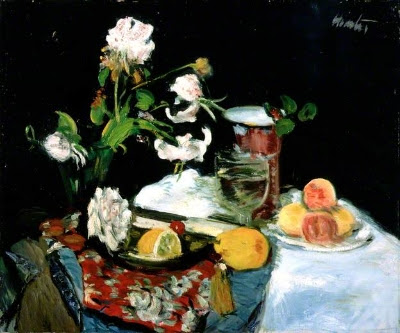
Samuel Peploe:  "Tulips--the Blue Jug"
National Galleries Scotland


As you might remember, we had scheduled an Isle of Skye painting retreat for this past summer.  But, as with many plans for 2020, things changed.  And because we didn't know what the summer of 2021 would be like—would the vaccine come soon enough?—we cautiously rescheduled it a little farther out, for 2022.

But this hasn't stopped us from yearning.  Our Google Chromecast device, hooked up to our TV, tempts us with a slideshow from our past trips whenever we're waiting for a movie to load from Amazon.  It's a joy to see—you can't take a bad photo anywhere on the Isle of Skye—and a reminder of what we'll find waiting for us when we do get back.

Recently, Trina came across a Zoom lecture series on the Scottish Colourists.  Having seen an exhibit of their work at Glasgow's Kelvingrove Museum a few years ago, I immediately signed up.  Four hour-long lectures for only 12£ (a little over $16 USD)—a real bargain.

“An Introduction to the Lives and Works of the Scottish Colourists,” hosted by the Berwick Educational Association and presented by Prof. Maria Chester, set the scene by examining the historic relationship of Scotland and France—a necessary step, since the Colourists spent most of their painting years in France—and then, after an overview of what the Colourists were all about, dived into detailed biographies of each of the four artists.  Although their paintings excited me at the Kelvingrove, I still didn't know much about them, so I enjoyed learning more through this very professional presentation.

So who where the Scottish Colourists?  From the National Galleries Scotland web site:

The term ‘Scottish Colourists’ describes four Scottish painters, Samuel John Peploe, F.C.B. Cadell, G.L Hunter and J.D. Fergusson, a set of radical artists in their day who enlivened the Scottish art scene with the fresh vibrancy of French Fauvist colours. Although the name suggests they were all living and working together in Scotland, they were not a close knit group with a specific set of aims, and only exhibited together on three occasions while they were all still alive.

Although early paintings suffer from a rather dull, tonalist style, their time in early 20th century France drenched their later work in color.  Portraits, landscapes and still lifes all pulse with color—not quite as crazy as some Fauvist work, but exciting nevertheless.

You can read more about them here:  https://www.nationalgalleries.org/art-and-artists/glossary-terms/scottish-colourists

Next time we're in Scotland, I'm hoping to see more of their work.

F.C.B. Cadell: "Iona Croft"
National Galleries Scotland

J.D. Fergusson: "La Voile Persan"
Hunterian Museum and Art Gallery

G.L. Hunter: "Still Life"
Dundee Art Galleries and Museum


Sunday, December 13, 2020

Wilson Hurley: Painter of the Big Landscape

Central panel, “The New Mexico Suite,” by Wilson Hurley, 1992.  16'x16', oil on canvas. 
Collection of the National Cowboy and Western Heritage Museum


Not too long ago, a friend, an accomplished painter and critic of art, announced that he'd just gotten a new book.  “It's the best art book I've ever seen,” he said.  The subject:  New Mexico artist Wilson Hurley.  I've admired Hurley's work over the years, and looking for a gift for my birthday, Trina bought it for me.  With gorgeous reproductions and a detailed life story, The Life and Art of Wilson Hurley: Celebrating the Richness of Reality is, indeed, one of the best books I've come across, too.

Wilson Hurley (1924-2008) is perhaps most famous for his large-scale depictions of the West.  If you've ever flown into the Albuquerque airport, you might have seen “La Cueva Sunset, East”  and "La Cueva Sunset, West." The vast size (63”x135”) of these two paintings brings to the visitor the grandeur of Albuquerque's Sandia Mountains.  They are impressive, but not his largest paintings.

Hurley attended West Point, flew fighter jets over the Pacific in World War II, got a law degree and then became what he called a “Sunday painter.”  But after founding a bank and working as an engineer at Sandia Labs—yes, he was a man of many talents—he went full-time as a painter.  The only thing that interrupted his long career as an artist was the Vietnam war, in which he went back into the military as an air traffic controller.  When he returned to painting, he found himself painting large-scale commissions such as the five triptychs for the National Cowboy and Western Heritage Museum:  The New Mexico Suite (1992), The California Suite (1993), The Arizona Suite (1994), The Utah Suite (1995) and The Wyoming Suite (1996).  As an example of the size of some of his larger pieces, the central panel of The New Mexico Suite alone is 16 feet by 16 feet.

All of this large studio work was based on smaller plein air studies:

His early painting procedures involved making pencil sketches, detailed color notes and photographs.  Above all, he relied heavily on his visual memory. … He became convinced that accurate color and values are best determined by painting directly from life.  … He saw his own work improve, and he became a relentless advocate that truth in atmospheric perspective, values and color comes from mixing paint and working directly on the studies outdoors.

Hurley is quoted:

"In the field, I first do a few compositional studies in pencil and then go to work directly in oil, mixing my colors in the shadow of my panel, the palette lit by the overhead sky.  Mixing color in sunlight is much too bright for control, and mixing under an opaque umbrella or shade causes the palette to be flooded by orange or  yellow light that reflects off the surrounding ground.

"The method of painting by overhead sky light seems to give me the freshest color and the best fidelity.  When the panels have dried, I lay them flat on my taboret in the studio and touch my mixed color to them until I have a complete match.  Then I use these colors to paint the larger painting.”

(As an aside, I've learned over the years that most professional studio landscape painters also paint en plein air; but for them, it's not a “thing” on its own but just part of being a painter.  They don't make a big deal of it.)

The book, besides being both biography and catalog, contains sections on Hurley's studio, materials and technique.  As a painter, I particularly enjoyed reading these sections.  But I will warn you:  At 380 pages, this book is heavy, tipping the scale at nearly seven pounds.  The only way I could work through it comfortably was while lying on the couch with a pillow supporting it.  But I do think that is the way a coffee table art book should be enjoyed, and with a cup of hot tea.

Here's an interview with Hurley: https://www.youtube.com/watch?v=scm1vlp1XWI 


The book is available from Amazon:  https://www.amazon.com/Life-Art-Wilson-Hurley-Celebrating/dp/1934491675 

"La Cueva Sunset, East" by Wilson Hurley, 63"x135", oil on canvas.
Collection of the City of Albuquerque.


Sunday, September 27, 2020

Ghost Ranch Revisted—and an Upcoming Retreat

Ghost Ranch Morning
9x12 Oil - Available


Ghost Ranch and Abiqiui, New Mexico—Georgia O'Keeffe's old haunts.  These are my old haunts, too, as I've visited and painted in the area many times over the last 20 years.  This time, I spent three days there, painting in gouache and oil, and in reading Lesley Poling-Kempes' history of the property, Ghost Ranch.  


The cottage O'Keeffe stayed in when
first at Ghost Ranch. I doubt the handicap
assist rails were there in her day.


Base camp was our 1999 PleasureWay van, parked in a side canyon formed by a bent arm of red and grey hills.  We were nestled right in the crook of the arm.  From our post, we could see the blue anvil-head of the Pedernal.  O'Keeffe once said, “It’s my private mountain. It belongs to me. God told me if I painted it enough, I could have it.”  The mountain overlooks the entirety of the historic Piedra Lumbre Land Grant, a region of colorful hills, deep arroyos, and bright cliffs—“Piedra Lumbre” means “shining rock.”  Ghost Ranch occupies 21,000 acres of this stunning and very paintable landscape.

Once a dude ranch, and before that, the legendary home of the Archuleta brothers, who were notorious cattle rustlers, it now belongs to the Presbyterian Church.  The campus now offers many workshops and retreats, not just in spiritual matters, but also in the arts.  But for painters, Ghost Ranch is best known for its connection to O'Keeffe.  She started spending summers there as a guest in the 1930s.  After her husband, Alfred Stieglitz, died, she bought a piece of the ranch and moved there permanently.  Between her Ghost Ranch home and another house she owned in nearby Abiquiu, she spent the rest of her life—over forty years—painting the hills of the Piedra Lumbre.


The Ranch, with Chimney Rock illuminated
by the morning sun.

While reading Poling-Kempes' history, the characters that lived in this place were ever-present for me as I painted.  I couldn't help but think of them crossing the landscape on foot or on horseback through the sagebrush, or of guests arriving via the Ranch's Lincoln touring car, a behemoth that could hold seven passengers plus luggage and still somehow lumber over the one-lane dirt road, down through arroyos and over rock-strewn hills, that wound for forty miles from the train depot in Española.  And, of course, I imagined Georgia O'Keeffe, painting away at the foot of some particularly colorful hill that was cut by the rare rains into graceful curves.


Our trip wasn't all painting.  We hiked, too.


As some of you know, we had to cancel our Taos, New Mexico, painting retreat for this fall.  But we are planning for next year—and as a bonus, we are going to schedule in some time for painting at Ghost Ranch.   We'll spend a week in Taos, and then follow that with time at Ghost Ranch.  The Taos retreat will start Sunday evening, September 26, 2021, and will run through Friday, October 1.  Ghost Ranch, which won't officially be part of the retreat, will be that weekend.  Let me know if you're interested, and I'll send you details as we get them.  I hope you'll join us!

Here are some of the 5x8 gouache sketches from the trip:


View from the campground


This was the preliminary sketch I did for
"Ghost Ranch Morning".  I sketched this
the day before I did the oil version.


Wednesday, July 1, 2020

Awakening in Taos: The Mabel Dodge Luhan Story


I can't recall ever having blogged about a movie before, but after seeing Awakening in Taos: The Mabel Dodge Luhan Story last night, I wanted to share it.

I've painted in Taos, New Mexico, many times, and it's one of my favorite locations.  Why?  It's not just the scenery—beautifully-sculpted adobe houses, often nestled among golden-leaved cottonwoods; broad-shouldered Taos Mountain watching over the village; and the deep, black gorge of the Rio Grande—but also its history.  Artists discovered the beauty of Taos in the very earliest years of the 20th century.  Instrumental in bringing artists to Taos was the socialite Mabel Dodge Luhan.  She invited many painters, photographers, writers and sculptors to her home, including Georgia O'Keeffe, John Marin, Willa Cather, Ansel Adams and Marsden Harley.

Over the years, I've led many students and retreat participants to Taos.  We've even painted on the grounds of “Los Gallos,” Mabel's estate, and have toured the interior.  I'm looking forward to our next retreat this October.  (The retreat is filled, but I will be happy to put you on the wait list.)  I like Taos so much that I am making this fall painting retreat an annual event.

The movie tells the story of how Mabel got to Taos and what she found there.  What's more, the movie is beautifully filmed, and shows the Taos landscape at its finest.  I suggest you rent or buy the movie here:  https://awakeningintaos.com/ .  And for more on Mabel, visit this site:  https://www.mabeldodgeluhan.com/

Detail of "Los Gallos"
You'll note the chicken on the right.

"Los Gallos" in early spring.

Mabel's gravesite.

A little sketch I did while at "Los Gallos".
"Mabel's Gate" 9x12 Oil.


Sunday, May 3, 2020

The Wellivers: Father and Son

Old Windfall
1981-1982
Oil on Canvas, 96”x120”
Neil Welliver
Courtesy of Alexandre Gallery

Neil Welliver at work in the field

Neil Welliver's studio palette

I'm a fan of well-done crime shows.  Lately, I've gotten hooked on Amazon's “Bosch.”  It's about an L.A. Detective with strong principles but who doesn't always follow the rules.  The detective, Hieronymous Bosch—named after the 15th century painter from the Netherlands—is played by actor Titus Welliver.  Somewhere in my web surfing I came across a curious fact.  Titus Welliver is the son of well-known Maine landscape painter Neil Welliver.

Neil Welliver (1929-2005) is one of my favorite painters.  His work is realistic yet graphic in a posterized sort of way.  His paintings of deep woods evoke for me the feeling of a long hike through a forest thick with hemlock and strewn with moss-covered glacial erratics.  When I see a painting like the one at the top of this post, I can almost smell the ferns.

Here's what Wikipedia says about the artist:
Welliver was born in Millville, Pennsylvania. He graduated from the Philadelphia College of Art (now part of the University of the Arts) and then received an MFA from Yale University. At Yale, he studied with the abstract artists Burgoyne Diller and Josef Albers, whose theories on color were influential.  Welliver taught at Cooper Union from 1953 to 1957 and at Yale from 1956 to 1966. In 1966, he began teaching at, and eventually became chairman of the University of Pennsylvania Graduate School of Fine Art, from which he retired in 1989.
While teaching at Yale, Welliver's style evolved from abstract color field painting to the realistic transcription of small-town scenes in watercolor. In the early 1960s he went to Maine, where he began painting figures outdoors, the large oil paintings often focusing on his sons canoeing or female nudes bathing. In 1970 he moved permanently to Lincolnville, and by the mid 1970s the figure as subject had given way to the exclusive study of landscape. 
His mature works, often as large as 8 by 10 feet, are at once richly painted abstractions and clear representational images of intimate Maine landscapes, taking as their subjects rocky hills, beaver houses, tree stumps, and rushing water, occasionally opening out to blue cloud-laden skies. Carrying his equipment on his back, Welliver hiked into the woods to make plein-air sketches. His equipment-laden backpack weighed 70 pounds, and included eight colors of oil paint: white, ivory black, cadmium red scarlet, manganese blue, ultramarine blue, lemon yellow, cadmium yellow, and talens green light. These plein-air studies usually took about 9 hours, and were painted in 3 hour increments, after which time the light would change too much to continue. Welliver insisted that he was uninterested in trying to copy the exact colors of objects, desiring instead to find "a color that makes it look like it is, again, surrounded by air.” 
He often painted out of doors in winter, and enjoyed the crystal quality of the air and luminosity created by light reflecting off snow, but acknowledged that the process was not easy:
"Painting outside in winter is not a macho thing to do. It's more difficult than that. To paint outside in the winter is painful. It hurts your hands, it hurts your feet, it hurts your ears. Painting is difficult. The paint is rigid, it's stiff, it doesn't move easily. But sometimes there are things you want and that's the only way you get them."
Welliver later expanded some of the outdoor studies into large paintings in the studio, painting 4 to 7 hours a day, meticulously starting the canvases in the upper left-hand corner and finishing in the lower right. If the finished paintings were vibrantly painted, containing "an emotional intensity that goes beyond the ordinary limits of realism", they also tended to be emotionally sombre. 
Welliver died of pneumonia in Belfast, Maine, near his home in Lincolnville.
Here's a 30-minute video of Neil Welliver making an outdoor sketch and then moving to the studio to paint a larger version.  (Can't see the video?  Here's the link: https://www.youtube.com/watch?v=ht_5csln19k)  I find it fascinating that he used the old charcoal-and-pounce method for transferring his  drawing to a large canvas.


Son Titus learned initially from his father and then studied art at Bennington College.  Although he doesn't say in so many words, I believe his father was as strict with him regarding technique as N.C. Wyeth was with his son, Andrew.  In this interview, he talks about his father and painting.  (Can't see the video?  Here's the link: https://www.youtube.com/watch?v=0n_ihljNygQ )


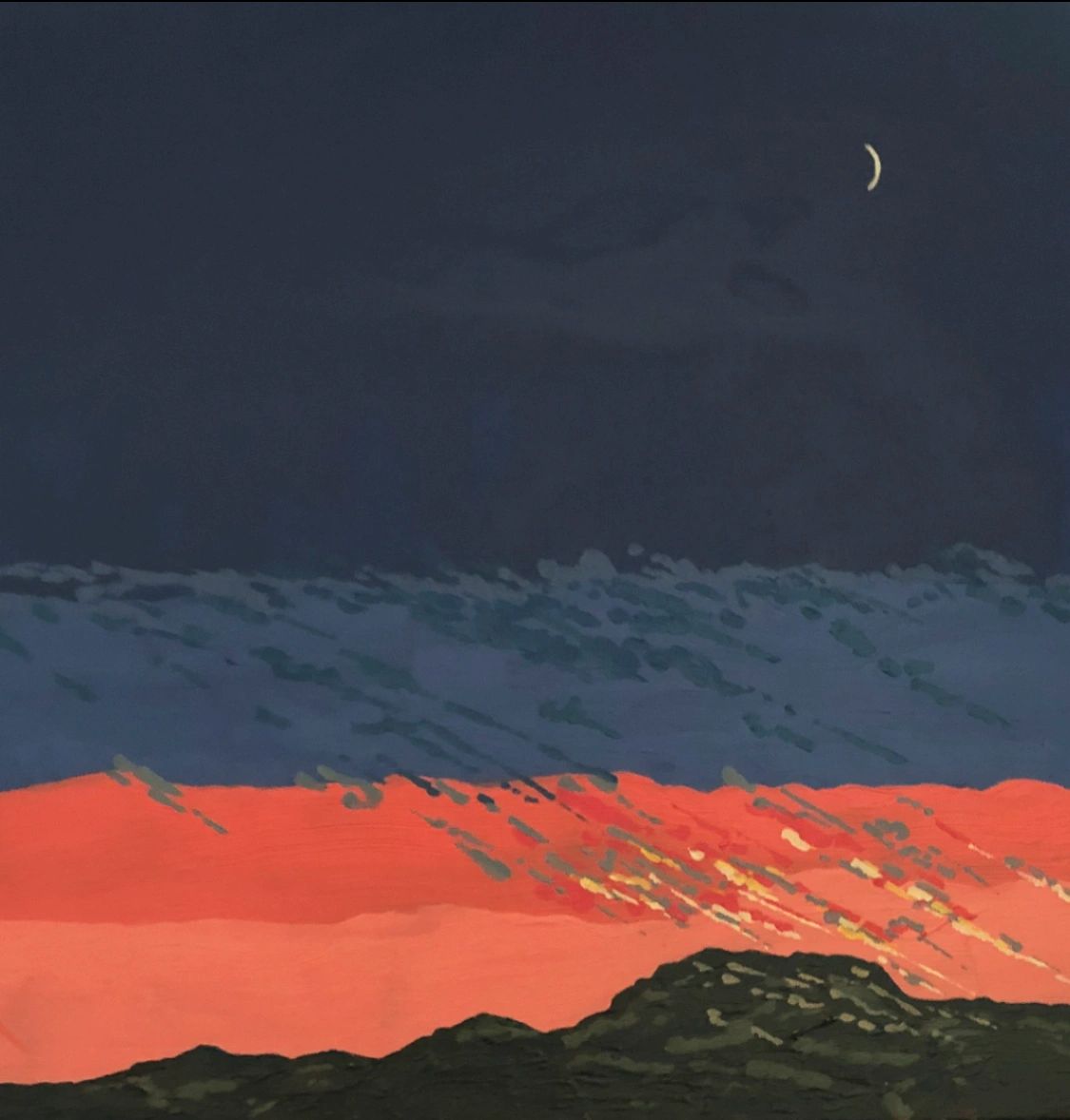
Titus' painting style, although similar to his father's in that values are reduced and shapes flattened, tends to have an even more contemporary feeling.  Uncluttered by unnecessary detail, his paintings distill the landscape into a few, evocative shapes.  Here's an example:


Concerto No.5 in F Minor
Acrylic on Canvas, 20" x 20" 
Titus Welliver
Courtest of artrep-dg.com

Sunday, March 22, 2020

Wolf Kahn (1927-2020)

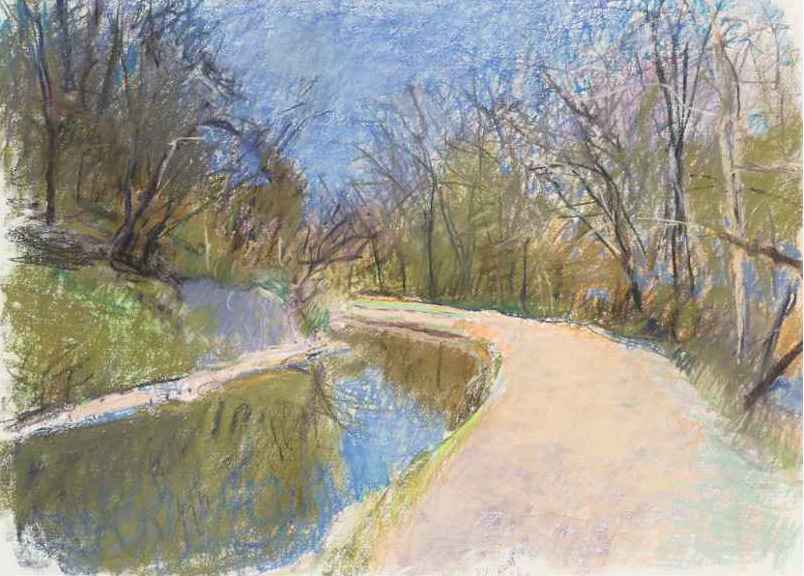
"Bend in the Chesapeake Ohio Canal"
Pastel, 21x29
by Wolf Kahn
Courtesy of The Granary Gallery


Wolf Kahn died this past week, aged 92.  I never met Kahn, nor his wife, fellow painter Emily Mason, who died last December.  When I first started working in pastel, there was much talk among pastel painters about him.  Although he worked in oil, he was one of the few well-known painters who also worked regularly in pastel.  I am always surprised by his sometimes-subtle, sometimes-raw expression with color.  His mastery flies lightyears beyond mere technique; his paintings possess a kabbalistic yet childlike quality that many try to imitate without success.

Originally from Stuttgart, Germany, he came to America during the Hitler years.  He studied with Abstract Expressionist Hans Hoffman and soon became his studio assistant. In New York City, he and other Hoffman students founded the Hansa Gallery (named after their teacher.)  In 1968, he and Emily purchased a farm near Brattleboro, Vermont, where they spent time when not in the city.

From his website, www.WolfKahn.com :
The unique blend of Realism and formal discipline of Color Field painting sets the work of Wolf Kahn apart. Kahn is an artist who embodies a synthesis of artistic traits—the modern abstract training of Hans Hofmann, the palette of Matisse, Rothko’s sweeping bands of color, and the atmospheric qualities of American Impressionism. The fusion of color, spontaneity and representation has produced a rich and expressive body of work. 
A painter friend of mine once remarked that Kahn was a painter who understood that sometimes you don't have to take a painting any further than the underpainting to call it done.  Many of his paintings do look like underpaintings; yet, to my mind, they have an “implied” or “predicted” finish in the way he made marks with pastel or brush.  You knew where he was going with it and didn't need any more.

Although both of us at one time lived in Vermont concurrently, I never had the pleasure of meeting Kahn.  My mentor years ago, Ann Templeton, had, and she once took a workshop with him.  She told me that he never let a student take more than one; he didn't want to turn out a bunch of little Wolf Kahns but hoped each student would find his own way.  When we were working on her book, The Art of Ann Templeton: A Step Beyond, she felt he had been such a mentor to her that she called him up to ask if he might contribute an image for the chapter on her teachers.  He respectfully declined, adding that he had stopped teaching.  With the onset of macular degeneration, he had decided to put all his energy to just painting.

Sunday, February 23, 2020

Encounter: Albert Handell Studio Oil Painting Workshop


This weekend, I'm attending a four-day workshop at Albert Handell's studio in Santa Fe. It's a small group of just four students, which means each of us gets a big piece of the pie. I remember taking a workshop from Albert perhaps 20 years ago, and there were 15 or 20 of us. That piece of pie, though nourishing, was small. It's a real treat to have so much pie it's hard to clean your plate.

Better yet, this is pie with ice cream. Albert has a spare bedroom, and he invited me to stay with him. I don't think this is an offer he extends to everyone. Albert and I have become good friends over the years. I've helped him run workshops both back east, in Lubec, Maine, and also out west, in Sedona, Arizona. (We're doing another one in Sedona this November.) Working with a professional--and  one of our true living masters--is a real pleasure.

Plus, Albert has another side. He loves documentaries. Yes, one might say painting is to Albert like earth, air and water are to an oak, but he relishes a historical documentary on, say, the Battle of Midway or the Diaspora. Over dinner, more often than not, the conversation turns away from painting to an interesting fact he picked up from the History Channel. In that way, he's like me, and we enjoy talking about a variety of subjects.

But he will talk about art and the art life and his paintings, if you ask. About his mother, who gave him his first French easel. About his days at the Art Students League and learning under Frank Mason. About the three framed, beautifully executed sketches on his dining room wall, each of which seems to feature an antique automobile from the 1950s. "That was my first car, a Pontiac," he explains.

One thing I'm learning this week is that mastery of painting is about the small things, not the big things. It's about a touch of pure ultramarine blue. The scratch of a knife. The understanding that finishing is not the point. And that these small things become a Big Thing.

Here are a few of the paintings I'm working on this time. I'll post the final versions later


.

Sunday, February 9, 2020

Escape from Mud and Snow

"Evening Cliffs" 9x12 Oil - Available

In my last post, I whined about the mud and snow here in northern New Mexico.  Well, to take a little break from it all, Trina, Raku and I headed over to Sedona, Arizona, for a few days of R&R.  Hiking, mostly.  Sedona is a little lower elevation (5000 feet or less), compared to our 7000 feet, and drier, so any snow there long ago sublimated into another dimension.  It was good to get out on the trails.  Most of my trips to Sedona these days involve teaching a workshop, so I don't get to hike as much as I'd like.

Although Sedona's streets and sidewalks are more crowded than ever these days, thanks to an over-muscled Chamber of Commerce and city leadership, the trails are still quiet.  Especially if you get out before the cyclists start touring.  If we finish a hike before noon, we rarely encounter any.  And if we make sure to hike into the designated wilderness areas, we never see any at all—they're not allowed.  Although some of the cyclists respect the “rules of the road,” announcing themselves and giving way to hikers, many do not.  We've had some close moments, especially where on a narrow trail the choice was to either get run down by a herd of cyclists or dive into an acre of prickly pears.  Multi-use trails, in my mind, are a poor compromise.  My advice—hike early or head for the wilderness.

But it wasn't a trip without a little painting.  My Sedona painting friend, M.L. Coleman, invited me to go painting one afternoon.  Joining us would be one of his other friends, Larry Pirnie.  I'd never met Larry before, but he's an artist well-known for paintings of cowboys and other Western themes.  He's been an artist all his life, and it was Norman Rockwell who advised him to attend the Pratt Institute.  “But my recommendation won't mean anything,” Rockwell told him.  “They think I'm just an illustrator.”  From Montana, he's come down every year to Sedona to paint for a spell.  This year he wanted to focus more on the natural landscape.

We headed out to the eastern side of town, over by Courthouse Butte and Bell Rock.  There's not much to say about the afternoon except that the weather was warm, the company pleasant, and the painting superb.  Oh, and no mud.  Life doesn't get any better.

Me, M.L. Coleman and Larry Pirnie.
And Raku.  That's Larry's painting on the easel.