Authentically Human! Not Written by AI!
All Content Copyright © Michael Chesley Johnson AIS PSNM

Friday, September 8, 2006

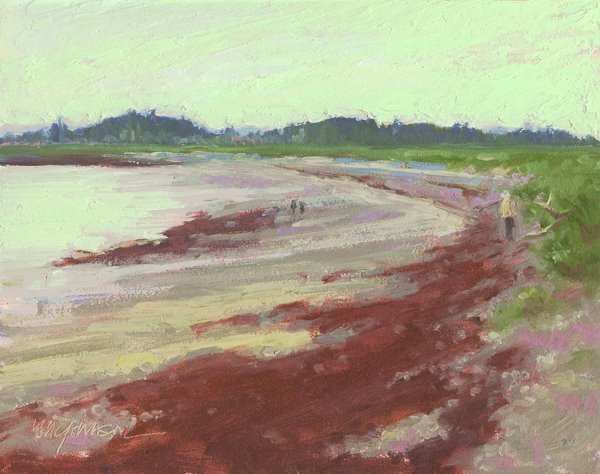
Lower Duck Pond, Lowering Sky

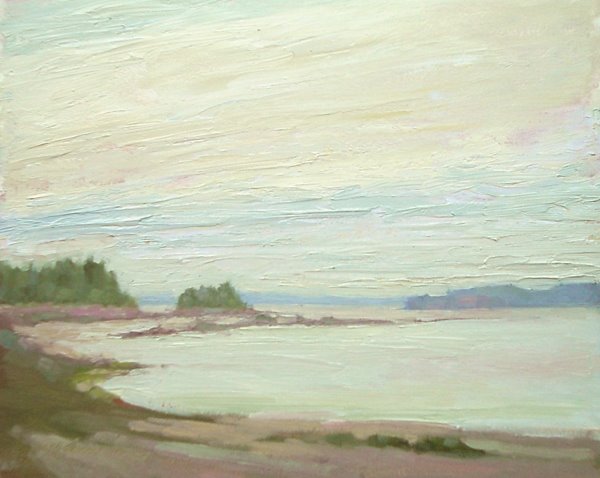
"Once in a while, you do a painting that is five years ahead of you," says my friend and mentor, Ann Templeton. This little plein air oil (8x10) seems to me to be in that class, but then, I won't truly know for another five years, will I? Others may also disagree with me. But I liked this painting and its expressionistic colour instantly. I'm not sure if the day looked exactly like this, but it's what came out of the end of my arm, green sky and all.

The scan doesn't show it, but the sky and the water to the left were painted with very thick paint, which conveys the feeling of a heavy, "lowering" kind of day where it'll probably rain in the next hour or so. Other paint is applied a little less thickly, but I still wouldn't call it thin. Toward the end of the session, three hikers came through, and they gave just the sense of scale I wanted for this broad expanse of beach and the long swatch of red, dried-up rockweed along it.

"Lower Duck Pond, Lowering Sky", 8x10, oil, e.p.a.
(as always, click to enlarge!)

Sunday, September 3, 2006

Focus

A still life painter uses a box to contain his oranges, apples and pears as he paints. This box gives him more control over lighting. But it also serves another purpose. It separates the arrangement from distracting backgrounds and the clutter of the studio.

The plein air painter has no such box. Whatever his subject, it sits in a world that writhes with distractions. Another interesting tree-shape, a building with a curious door, a colorful swath of meadow -- all things he didn't see at first, and all of them just outside his chosen frame -- compete for a place in the painting.

If we plein air painters had such a box, fewer of our paintings would go astray. If we could carry out to the field, say, a duck blind on wheels, and paint inside that looking out, we might have better luck. But since "portable" is our motto, we must seek a better option. That option is the very portable one that consists of sheer will power. It's the ability to give up what else we would like to include and to stick with our first choice.

Where I live, which is by the broad ocean with breathtaking vistas of sea cliffs, I am often tempted to take in an extended range worthy of Albert Bierstadt. But when I set up my pochade box and my usual 8x10 panel, experience tells me to settle for less. If my first choice was a stunted, storm-blasted tree jutting up out of a field of wild roses, that is what I paint. I forgo the scenic piles of driftwood just outside my chosen view, and the scallop boats trawling the bay, and the waves crashing on the most distant cliffs, and -- but you get the point.

I tell myself that life is long, and I will eventually paint all those other scenes. This is not true, of course, but it does take the pressure off.

Monday, August 28, 2006

Finback

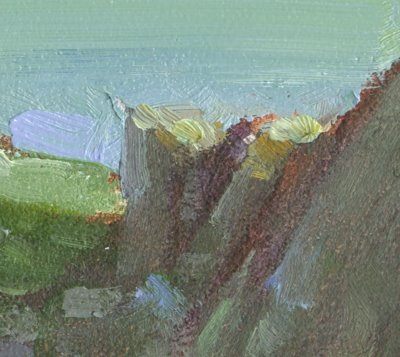
Lately, I've been drawn to rocks. It seems that many of the paintings are of interesting formations that stir up some antediluvian fantasy. Here's one. It's a rock over by Liberty Point. I call it "Finback" because it does look like a fin, and we do have finback whales here.

The challenge was the shadowed side of the rock. There was so much light bouncing around that the shadow had to be quite light, but still function as shadow. Keeping the shadows on the "cool" side and the light on the "warm" side worked well. I was able to push the value of the shadows high, but have them still read as shadow by keeping the temperature consistent.

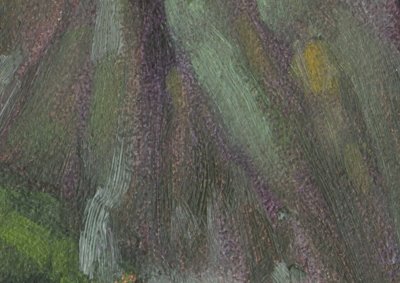
"Finback", 9x12, oil/panel, en plein air (PLUS detail shots!)


Friday, August 18, 2006

An Old Tradition Renewed

I write the occasional piece for the web-based ECVA* newsletter, and in the August 2006 issue, they've published "Plein Air Painting: An Old Tradition Renewed." If you're interested in reading this, please click on this link.
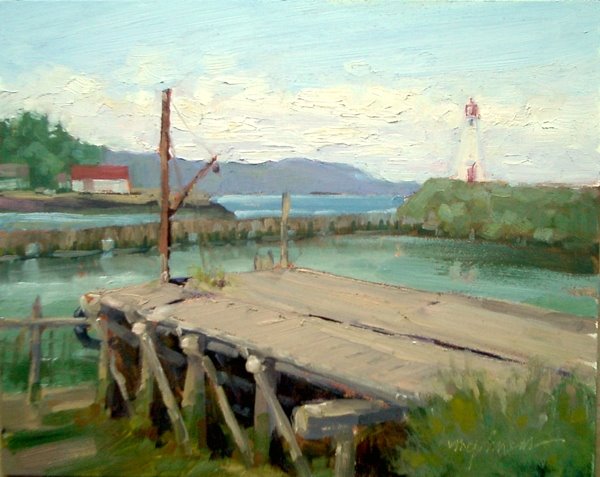
For your viewing pleasure: "Upper Duck Pond, Sky and Water", 8x10, oil/panel, en plein air
*ECVA stands for Episcopal Church & the Visual Arts. Web site address is www.ecva.org

Saturday, August 5, 2006

Ragged Point

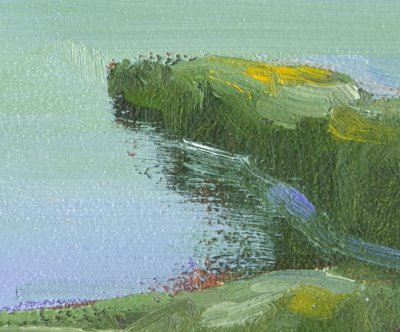
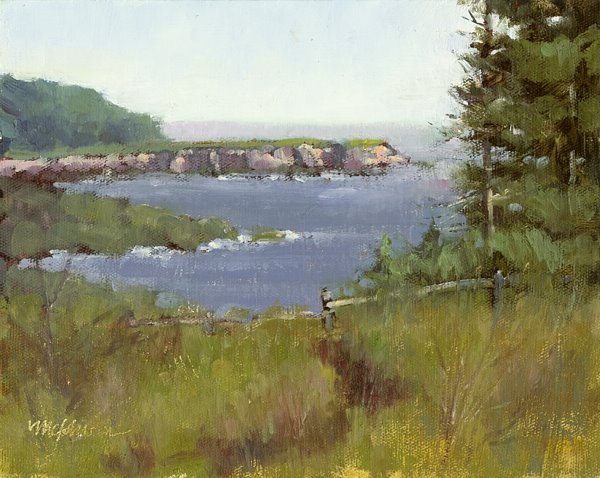
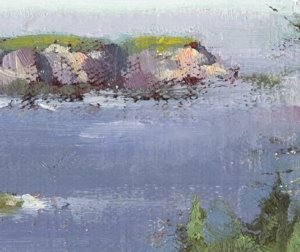
This is one of those paintings that painted itself. (Seems like I'm starting to say that more and more lately!) Part of the reason is that I was working on linen that had a couple extra coats of acrylic gesso laid on it to "kill" the linen texture. I don't like the woven pattern of canvas and linen, and when I run across a panel prepared with it, I always lay on more gesso. In this case, just enough texture was left so that my brushstrokes for the water and distant light on Ragged Point "broke" -- thus suggesting detail in a way that would have taken me many, many hours to create with a fine brush. You can see the effect in the detail.
"Ragged Point," 8x10, oil/panel, en plein air
Detail: