Authentically Human! Not Written by AI!
All Content Copyright © Michael Chesley Johnson AIS PSNM
Showing posts with label Utah. Show all posts

Sunday, April 14, 2019

Painters on Wheels: Northern Arizona

Monument Valley - This could be Mars

Every year, I try to take a road trip with my painting buddy, M.L. Coleman.  M.L. has a 22-foot Lazy Daze RV, just the thing for two painters who want to ramble the countryside and boondock to get the best views.  This year, since good spring weather seemed to have returned, we decided to head to northern Arizona, leaving from Sedona right after my plein air painting workshop there.

Navajo National Monument

Navajo National Monument
Stocked with ample groceries, fresh water and propane, we first went to Navajo National Monument, not far from Kayenta.  I'd never been there, and frankly, it was a little disappointing from a painter's point of view.  Our campsite—camping, by the way, is free at the campground in the Monument—gave us a view of the top of Betatakin Canyon, and we painted that first evening in the shade of the RV.  There are, of course trails taking you down into the canyon, but you need a guide for those.  There is one other trail, paved, that takes you to an overlook, but it's a bit farther than we wanted to haul our gear.  As this wasn't intended to be a hiking-to-paint trip, we walked the trail and only took photos.

We left the next morning, heading toward Black Mesa.  We'd seen some paintings of Black Mesa that featured interesting rocks, but Black Mesa, which is reached by a steep road, turned out to be mostly a coal mining venture.  And it was flat, flat, flat.  We got to a point where we spotted a sign that marked everything beyond it as belonging to Peabody Western Mining; it also directed us to stop at the security station.  When we asked the two security guards, who were washing down their trucks, if there was anything scenic to paint, they replied, "Nope, nothing scenic here.  But have you been to Monument Valley?"

Monument Valley

Our campsite at Monument Valley

What's a rez without a rez dog?

The easy way of plein air painting - doing your
value sketch in a chair

M.L. Coleman at work

I'd never been, but Trina had taken some wonderful photographs of the area after a camera club trip not so long ago.  Although we'd been thinking of simply heading to Canyon de Chelly National Monument—we'd painted there last year, and I discovered it is a very rich area for the painter—we decided Monument Valley wasn't far, so we thought to take a look.  It's just like you see in the ads, stubby buttes sticking up out of the otherwise flat earth, looking very alien.  (In fact, the red, sandy dirt reminded me a great deal of the photos taken by the Opportunity rover on Mars.)

We first stopped at the Visitor Center.  In a national park, I feel perfectly comfortable painting just about anywhere.  (The general rule is to stay on the trail but not block it.)  But Monument Valley is owned and operated by the Navajo Nation as a tribal park, and most tribal lands require a permit for photography, even if you're just a hobbyist.  We weren't sure if we'd be allowed to paint.  Our entrance fee ($20) to the Visitor Center did allow us to take photos there, but our RV was not permitted on the 17-mile scenic drive.  (Private cars are, however.)  So we took photos from the parking lot and, yes, we could have asked about painting, but we preferred a spot with fewer tourists.  On our drive out, we discovered a private campground (Air Bee and Bee) just outside the park and over the state line in Utah with great views and lots of quiet.  The owners didn't care if we painted or took photos during our stay, so we did plenty of both.

Outhouse with a view

Ravens keeping watch

Our campsite by Sleeping Bear

More rez dogs, always eager for a walk

We finally exhausted the views from that campground.  But before driving south to Canyon de Chelly, M.L. first wanted to head a little north to see what views we might find.  Unexpectedly, we came across another private campground even closer to the buttes.   This one was right below what Kirby Blackwater, the Navajo owner, called "Sleeping Bear."  He pointed it out to us, but you really had to stretch to see the bear.  When asked, he also described the boundaries of his land, which seemed to be about five square miles.  We ended up spending two nights at this quiet, scenic campground in the middle of nowhere.

Until our last day there, the weather had been warm—near 80 and above—and calm.  But then the wind kicked up.  That night, it gusted over 50 miles an hour, and the RV rocked like a hobby horse.  The wind, only somewhat lessened, would stay with us until the end of the trip, and it would be accompanied by rain and snow squalls and much colder temperatures.  The snow was a little surprising for April.  Still, the weather didn't stop us from painting.  Usually, we could find a spot somewhat out of the wind behind a tree or on the lee side of the RV.

This photo doesn't show the full strength of sandblasting winds

Snow squall

Me in a sunny moment

"Wind Advisory" 6x9 oil - available
Look closely, and you can see Martian sand embedded in the paint

Canyon de Chelly National Monument

We took the windiest, rainiest day to drive to Canyon de Chelly.  Although we'd camped at its main campground before, this time we headed up the hill toward Spider Rock, where we remembered seeing a campground there.  Although Spider Rock Campground didn't have the views—we set up in what I would call a "sage forest"—it was just a short drive from Spider Rock.  This is probably the most famous feature of the park.  Last year, it snowed when we were there, and we never got the chance to do more than take photos of it.  This time, again it snowed, and with some serious wind, so we thought we'd miss it yet one more time.  Well, the snow finally let up but the wind didn't, so we ended up seeking sheltered spots, none of which happened to give a view of Spider Rock.  Maybe next year we'll get it down in paint.

Spider Rock

Spider Rock in a snow squall (the raven is enjoying it)
Another snowy morning

With early spring, the canyon floor begins to whisper "green."  In our time at Canyon de Chelly, a good flow of water coursed through Chinle Wash, and you could tell that the pastures and fields and cottonwoods along its bank enjoyed the moisture.  I overheard a couple of tourists talking, and they said that the guided jeep tours had to stop temporarily because the water was too deep.  Some year, it would be good to take a jeep or horseback tour to find some painting spots down in the canyon.  But the rim has spectacular views and plenty of painting opportunities, and we headed back home satisfied, if a bit wind-blown.

Along with a few snapshots, I've included here a few of the sketches from the trip.

Now I am back home in New Mexico, teaching my last one-on-one painting intensive here for the season.  After that, I have a few weeks to work on house projects—no, I don't get to paint every day and every minute!—and then we will be on our annual springtime migration back east.

"Big Butte" 6x9 oil - available

"Face Rock" 9x6 oil - available

"In the Canyon" 9x12 oil - available

"Spring in the Canyon" 9x12 oil - available

"Weather Change" 6x9 oil - available

Monday, June 19, 2017

Going from Oil Field Sketch to Studio Pastel

Passage 24x18 pastel
by Michael Chesley Johnson

The other day, I wrote about taking a pastel sketch made in the field and using it as a reference for a studio oil painting.  This time, I want to address the reverse.  Earlier this spring, I painted several small oil sketches at Zion National Park in Utah at a retreat I organized for some painters.  One of the sketches really appealed to me, as I thought the moment it captured would make a stunning piece if painted much larger.  The oil sketch was only 9x6 inches; my plan was to make it 24x18, and to do it in pastel.

Oil field study, 9x6

I felt the sketch would translate fairly easily into a larger size without the need for photo references for detail.  So, I propped up the painting next to my easel and got to work.  After the block in, and once I began to adjust color relationships, the "detail" began to appear automatically—all without my having to refer to a photo.  Sometimes, the painting tells you what it needs, and also my experience in painting this kind of scene came into play.

I made the painting on a sheet of steel-grey Canson Mi-Teintes.  For my pastels, I used NuPastels for 90% of the painting and then finished with Unisons.  Because the Canson paper can only hold so much pastel, I used a little Lascaux fixative now and then to give the paper more "grip."  Also, I used it more heavily wherever I needed to darken a passage.  At the end, I used the sharp edge of a dark blue pastel to add three small ravens over the central cliff to help with the sense of scale.  Here are some detail shots:


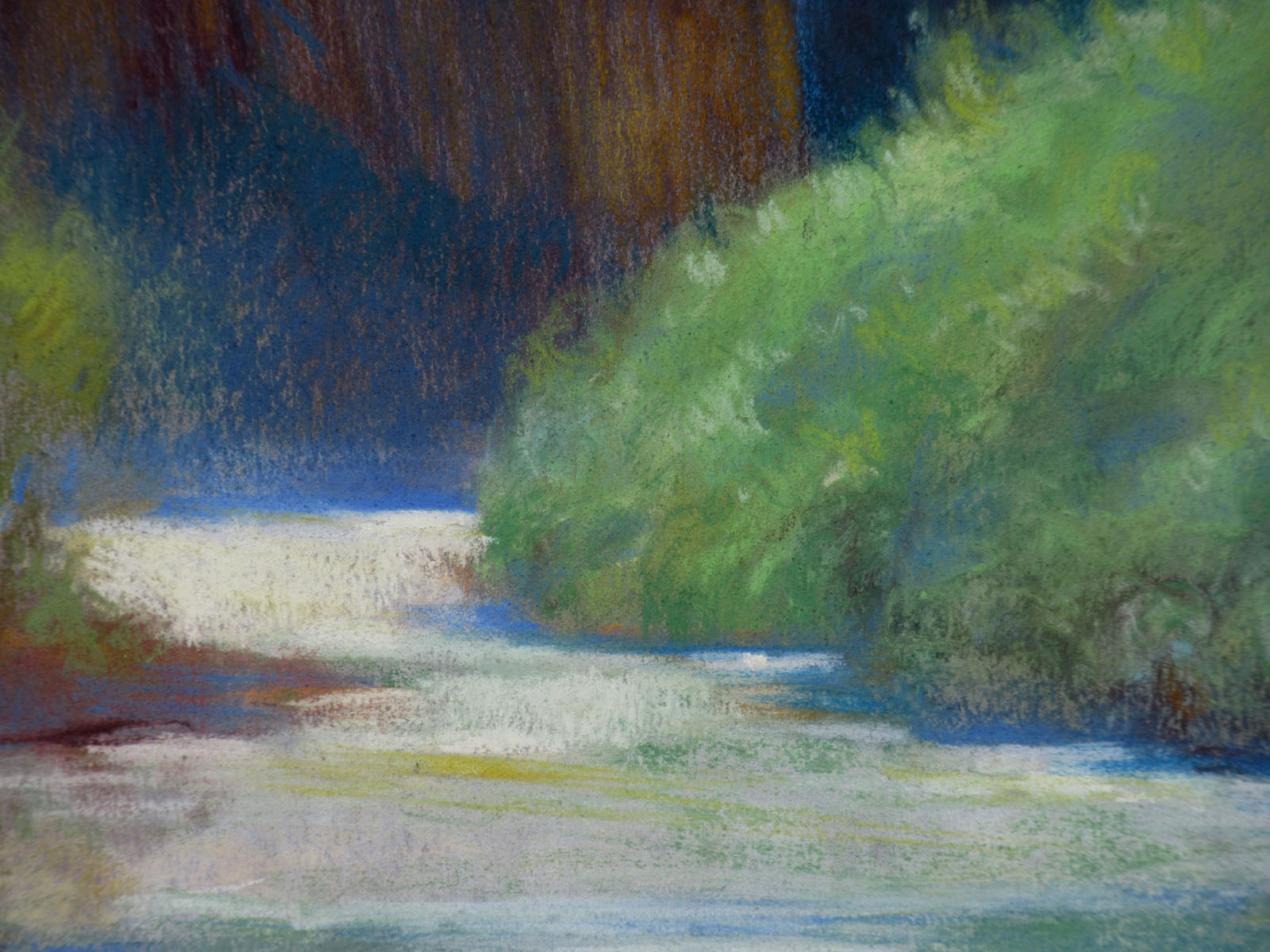
I painted the original small field sketch because I'd fallen in love with the shadowy blue that you see as you look down the length of the Virgin River in the early morning.  I think I was able to preserve this beautiful blue in the larger pastel.

I put together a short video that shows some of the process, below.  For those of you receiving this post via e-mail, you can see the video at this link

Saturday, April 29, 2017

Zion National Park 2017 Painting Retreat - Final Report

Big Bend I 9x6 oil by Michael Chesley Johnson

Some readers have been curious about what colors I used for my painting retreat at Zion National Park this week.  Well, in addition to my usual split-primary palette, I added a few "convenience" colors; these are colors that I could, if I wanted to, mix with my split-primary palette, but which I decided to include to save time.  The colors are raw umber, transparent earth red and yellow ochre, all Gamblin colors.

Raw umber greys down ultramarine blue nicely.  Transparent earth red (TER) is a great base color for the shadowed parts of Zion's cliffs.  Yellow ochre, for the warmer, sunlit areas.

I started each painting by first blocking in the rock shadow masses with transparent earth red.  Although this is a very rich, warm red, it is easily greyed down as needed with yellow ochre, raw umber and ultramarine blue (plus white.)  Some of this rich underpainting always remains, adding a little spice to the landscape.  Sunny rock areas I block in with yellow ochre.  Together, these colors give good value and temperature contrast.  Later, I use many other colors to modulate them to get the correct local color and atmospheric effect.

Our week ended with a painting session at Big Bend, near the end of the shuttle line and below stupendous, vertical cliffs that are favored by rock climbers.  I've always loved Big Bend, especially in the morning, since the rising sun lights the cottonwoods along the banks of the Virgin River from behind, giving them a beautiful halo.  I've painted here several times before, once for the Zion Plein Air Festival in the fall, when the cottonwoods were decked out in their autumn beauty.  This time, I made two small color studies, which I hope to turn into larger studio paintings later.

Big Bend II 6x9 oil by Michael Chesley Johnson
To paint the two studies, I simply divided my panel in half with a
piece of masking tape.  Later, I'll use a utility knife to cut them apart.

It's always sad, parting at the end of these retreats, but there'll be another one at Zion in a few years.  Now, Trina and I are on our way to the east, but first – a stop at Capitol Reef National Park.

Backlit springtime cottonwood

Goodbye to the Virgin River!

Thursday, April 27, 2017

Zion National Park 2017 Painting Retreat - Another Midterm Report

The Watchman 9x12 oil by Michael Chesley Johnson

Two things you can't get from a photograph are depth and color.  To get a real sense of the depth of the landscape, you need to be looking at it with two eyes.  Stepping back and forth in front of your subject enhances the effect, allowing you see clearly what's in front of what, and how shapes are modelled.  As for color, cameras have improved greatly since George Eastman's day, but nothing yet beats the sensitivity of the eye.  Working from life, en plein air, in the field, outdoors, is the only way to truly capture the moment.

Here in Zion National Park, there's plenty of opportunity to experience depth and color.  When you're in the canyon, along the river, you are right up against the rocks.  When you're higher up, like at Kolob Canyons, you have more of a vista.  In both cases, depth and color play key parts in the experience.

I find color especially fascinating here.  From the blood-red stains on the West Temple to the ivory white of the Great White Throne to the subtle blues and purples in the canyon shadows, the Park offers a wealth of color.  When I go out to paint, the first question I ask myself is:  Should I paint the color literally?  Or should I "push" the color to enhance the sense of the moment?

I don't have an answer for this.  Sometimes I'm accurate with the color, and the paintings fill with the beautiful muted tones of the realistic landscape.  At other times, it seems right to saturate the color a little more.

Since Kolob Canyons on Tuesday, we've painted at Court of the Patriarchs, Canyon Junction along the Virgin River and the Nature Center, as well as at a little pull-off I found up near the tunnel that has a view of West Temple.  It's been a surprisingly tempestuous week with the weather.  I'm used to the usual breeze that comes down the canyon without fail each dawn, but afternoons have suffered clouds and high winds.  Still, we've found spots hidden from the wind, making for a very successful week thus far.  It's hard to believe we have only a couple of days left!

Shadow of a Patriarch 12x9 oil by Michael Chesley Johnson

The Sentinel 9x12 oil by Michael Chesley Johnson

Penstemons!  It pays to look at more than just the vistas in the landscape.

View of West Temple

Kayakers passing by our painting spot at Canyon Junction

A quiet respite along the river

Location shot for my painting of The Sentinel

Home-cooked gourmet meals!  Courtesy of our participants.

Tuesday, April 25, 2017

Zion National Park 2017 Painting Retreat - First Midterm Report

Court of the Patriarchs

The best thing about Zion National Park—and also its most challenging—is its bountiful offering of both beautiful vistas and more intimate scenes.  Every turn in the road gives you endless possibilities.  The question I always ask myself is, Should I paint a postcard?  Or something perhaps   more "artful" and less cliché?

When the artist travels to a famous place that is new to him, it's tempting to paint something that resembles the postcards he sees in the tourist shops.  Postcards do a good job of capturing the awesomeness of a vista or the character of a landmark.  The idea behind a postcard, of course, is to give the folks at home a glimpse that may entice them to visit, or, for the visitor, to provide a memory of the place visited.  Here at Zion, you'll find postcards of Angel's Landing, a soaring rock tower, with the Virgin River lazily snaking far below it.  You won't, however, find postcards depicting close-ups of a sandstone boulder basking in the sun at the water's edge.

Angel's Landing

For me, it's always a struggle deciding what to paint when I visit a famous place packed with beauty.  Angel's Landing occupies postcards for a reason—it is indeed beautiful and awe-inspiring.  And there's a spot where you can stand and paint that iconic scene.  But the painting will most likely turn out as trite as the postcard.  What if I choose a different location?  A different time of day?  Decide to do more of a close-up of the base, omitting the tower's top?  Use an "edgier," more contemporary style?  If I think "outside the postcard," maybe I can come up with something more interesting but still convey a sense of place.

It's always good to have a plan when you go outdoors to paint.  (I talk about this at length in my plein air painting workshops.)  For painting in famous places, here are some possible goals:

  • Paint the postcard view (easy but not very satisfying creatively)
  • Paint the iconic landmark from a vantage point that is purposely different from how it is usually depicted
  • Forget the icons, and go for conveying a sense of place by focusing on typical subject matter
  • Or go for conveying a sense of place by focusing on color and light rather than subject
  • Or treat the scene is an edgier, more contemporary way

Another question I ask myself is:  Is it more satisfying to paint a study or a "picture"?  Creating a "picture" (a finished painting ready for the frame) is much more demanding because it requires all of your skills to be in top form.  Creating a study can be more relaxing because you may exercise only a few skills.

Over the last couple of days, we've been blessed with good weather, though the mornings have started off hazy.  Our first day, we went all the way up the canyon on the shuttle buses to the Temple of Sinawava; the second day, to the Kolob Canyons area, at the western end of the park; our third day, at the Court of the Patriarchs, one of my favorite spots to paint.  In some of my paintings here, you'll see the overcast start to the day and the lack of strong light; in others, you'll see stronger contrasts, indicative of more sun.  I don't think I've painted any postcards yet, but the week is still early.

Three painters, seen from Taylor Creek trail at Kolob Canyons

Painting at Kolob Canyons

Painting at the Temple of Sinawava
Yes, the vegetation was that lush and green!

Kolob Canyons - Painting Shuntavi Butte on a hazy-light day

Painting at Court of the Patriarchs, sunny but clouds moving in

Into the Narrows 9x12 oil by Michael Chesley Johnson
A 45-minute sketch after the haze cleared at Temple of Sinwava
I'll probably go out later this week to refine it or save it for a studio reference.

Overcast, Kolob Canyons 9x12 oil by Michael Chesley Johnson
A postcard view?  No, the postcard would have full sun!

Hazy Light, Shuntavi Butte, 12x9 Oil by Michael Chesley Johnson
Again, not a postcard, thanks to the hazy light.

View to the South, 9x12 oil by Michael Chesley Johnson
Another hazy day painting.

West Temple, Late Afternoon, 6x9 oil by Michael Chesley Johnson
An unusual angle of West Temple, with close cropping, so it doesn't qualify as a postcard, either.